Get the Westinghouse iGen5000DFc if:
- You want more power on gas: 5,000W starting and 3,900W running.
- You want propane as a backup fuel: 4,500W / 3,500W on propane.
- You want a listed automatic CO shutoff.
Inverter generators
The short answer
Our pick: Westinghouse iGen5000DFc
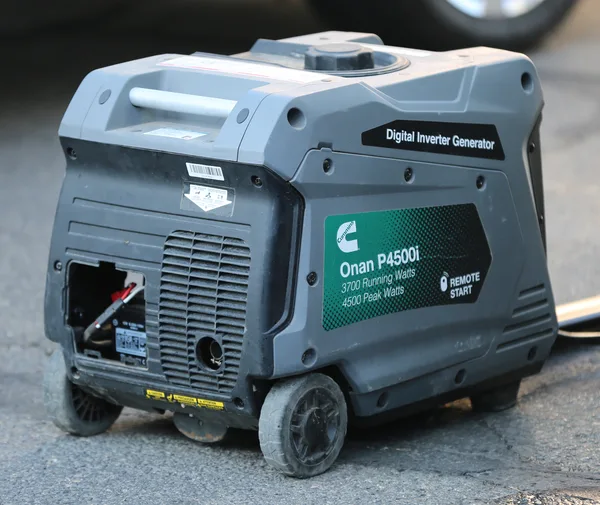
More watts (3,900W running vs 3,700W), a propane option and a listed CO shutoff. The Cummins is the pick in California: the linked A058U955 is EPA and CARB certified, and it is 7.8 lb lighter.
Best for outage backup
Best for California buyers
Full Cummins Onan P4500i review
Before you buy: The Westinghouse listing is a style family that includes 4000W models; make sure you're on the "5000 Watts - Dual Fuel - Remote Start" style. The Cummins listing is model A058U955, sold by a third-party seller. Both are non-returnable (hazmat). This page covers the carbureted iGen5000DFc, not the EFI version.
As an Amazon Associate I earn from qualifying purchases.
Counted from the chart below: rows where one figure is clearly better. It's a tally, not an overall rating. The CO row counts for Westinghouse because it lists a shutoff and Cummins' spec sheets don't. That doesn't mean the P4500i has none, only that Cummins doesn't list one.
A green check means one figure is clearly better. No check means it's a tie, it's close, the makers measured it differently, or a figure is Unknown. Maker figures are used throughout; anything marked Amazon only comes from the Amazon listing, not the maker.
| iGen5000DFc | P4500i | Clearer | |
|---|---|---|---|
| Starting / running watts (gasoline) | 5,000 / 3,900W | 4,500 / 3,700W | iGen5000DFc |
| Propane | Yes: 4,500 / 3,500W | No, gasoline only | iGen5000DFc |
| Engine | 224cc OHV, automatic choke | 224cc OHV, 7.3 HP, automatic choke | |
| Gas tank | 3.4 gal | 3.4 gal | |
| Run time at 1/4 load | 18 hr gas; 22 hr propane (tank not stated) | 18 hr (A058U955 sheet) | |
| Run time at 1/2 load | Unknown | 15 hr (A058U955 sheet) | |
| Noise (distance not stated) | As low as 52 dBA | As low as 52 dBA | |
| Outlets | TT-30R 30A, 5-20R duplex, 2x USB | TT-30R 30A, 5-20R duplex, 2x 5V USB | |
| 240V / 50A | None on unit; parallel kit adds a 240V outlet | None on unit; parallel for 50A RV | |
| THD | 3% or less | 3% or less | |
| Parallel | Yes, with a second iGen5000DFc (kit sold separately) | Yes, with P4500i, P4500iDF or P2500i (kit sold separately) | |
| CO shutoff | Yes, automatic | Not listed on Cummins spec sheets | iGen5000DFc |
| Start | Electric, remote fob, recoil; battery included | Electric, remote fob (109 yd), recoil; battery included | |
| Ground | Floating neutral | Floating neutral | |
| Dry weight | 105.8 lb | 98 lb | P4500i |
| Size (L x W x H) | 24.5 x 17.5 x 20 in | 24.5 x 18.25 x 20.5 in | |
| EPA / CARB | Not CARB compliant; EPA Unknown | EPA + CARB (A058U955) | P4500i |
| Warranty | 3 yr residential; 1 yr commercial | 3 yr residential; 1 yr commercial |
Common things people plug in during an outage or at camp, checked against each generator's own gasoline ratings from the chart above: iGen5000DFc 3,900W running and 5,000W starting, P4500i 3,700W running and 4,500W starting. I used the top of each range, so a smaller appliance may do better. These are estimates, not test results.
| Load | Running watts | Starting watts | iGen5000DFc | P4500i |
|---|---|---|---|---|
| Full-size refrigerator | 150–400W | 800–1,200W | Yes | Yes |
| Freezer (chest or upright) | 100–500W | 500–1,000W | Yes | Yes |
| Sump pump, 1/3 HP | 500–800W | 1,000–1,600W | Yes | Yes |
| Sump pump, 1/2 HP | 800–1,050W | 1,300–2,150W | Yes | Yes |
| Gas furnace blower (1/2 HP fan) | 300–800W | 800–1,600W | Yes | Yes |
| Window AC, 5,000 BTU | 450–600W | 900–1,200W | Yes | Yes |
| Window AC, 10,000 BTU | 900–1,200W | 1,800–2,400W | Yes | Yes |
| RV rooftop AC, 13,500 BTU | 1,500–2,000W | 2,800–3,500W | One at a time | One at a time |
| CPAP (with heated humidifier) | 60–120W | No extra | Yes | Yes |
| Microwave | 600–1,200W | No extra | Yes | Yes |
| Coffee maker | 600–1,200W | No extra | Yes | Yes |
| Space heater (1,500W setting) | 750–1,500W | No extra | Yes | Yes |
| Well pump, 1 HP‡ | 1,000–2,000W | 2,000–4,000W | No | No |
| Circular saw, 7-1/4 in. | 1,200–1,800W | 2,400–3,600W | Yes | Yes |
| TV (32-55 in.) + router/modem | 90–420W | No extra | Yes | Yes |
| Phone/laptop charging | 20–100W | No extra | Yes | Yes |
| Electric water heater‡ | 3,000–4,500W | No extra | No | No |
‡ Neither lists a 240V outlet on the unit, so 240V well pumps and water heaters are out. Westinghouse says its parallel kit adds a 240V outlet.
Add up the running watts. Then take the one item with the biggest starting surge and add its starting watts to everything else's running watts. Both totals have to fit. Estimates.
Running: 400 + 800 + 75 + 20 = 1,295W (iGen5000DFc 33% of 3,900W · P4500i 35% of 3,700W)
Biggest start: fridge starting 1,200 + everything else running 800 + 75 + 20 = 2,095W (iGen5000DFc 42% of 5,000W · P4500i 47% of 4,500W)
iGen5000DFc YesP4500i Yes
Running: 400 + 500 + 1,050 + 75 + 20 = 2,045W (iGen5000DFc 52% of 3,900W · P4500i 55% of 3,700W)
Biggest start: 1/2 HP sump pump starting 2,150 + everything else running 400 + 500 + 75 + 20 = 3,145W (iGen5000DFc 63% of 5,000W · P4500i 70% of 4,500W)
iGen5000DFc YesP4500i Yes
Running: 2,000 + 600 + 150 + 100 = 2,850W (iGen5000DFc 73% of 3,900W · P4500i 77% of 3,700W)
Biggest start: 13,500 BTU AC starting 3,500 + everything else running 600 + 150 + 100 = 4,350W (iGen5000DFc 87% of 5,000W · P4500i 97% of 4,500W)
iGen5000DFc YesP4500i Tight
These are typical figures. Check the label on your own appliance. It lists watts, or amps you can multiply by 120 to get watts.
Motors need starting watts. Fridges, freezers, pumps, furnace blowers and air conditioners pull a short surge each time they kick on, well above their running watts. Heaters, coffee makers and chargers don't.
Running several loads adds up. If two motors start in the same second, both surges stack. Start the big ones one at a time.
Load watts: Champion Power Equipment, Generator Wattage Chart. It covers appliances, not generators. Coffee maker range from Honda's wattage guide.
Both burn gasoline (the Westinghouse also propane), so both put out carbon monoxide. Keep them outside, away from doors, windows and vents. Westinghouse lists an automatic CO shutdown. Cummins' spec sheets don't list one, and its manual advises separate CO detectors. Use CO alarms in the house with either.
Same 224cc size, same 3.4 gal tank, same TT-30R. The deciding points are propane and CO shutoff for the Westinghouse, and CARB and weight for the Cummins.
As an Amazon Associate I earn from qualifying purchases.
if you live in California. Westinghouse says it is not CARB compliant.
if you want propane or a built-in CO shutoff. It is gas only, and Cummins doesn't list a CO sensor.
Where the maker and the Amazon listing (or two maker documents) give different figures. This page uses the maker figure unless noted.
Cummins doesn't list one on its spec sheets, so this page doesn't claim one. The operator manual advises using separate CO detectors.
Both have a TT-30R 30A outlet. Cummins says paralleling gets you to 50A for an RV.
Cummins publishes two spec sheets. The EPA+CARB A058U955 (the linked model) lists 18 hr / 15 hr at 1/4 / 1/2 load; the EPA-only 6543401 lists 15.6 hr / 10 hr. This page uses A058U955.
The linked Cummins A058U955 is CARB certified. Westinghouse says the iGen5000DFc is not CARB compliant.
By Mike E. · Last checked October 16, 2026 · Based on manufacturer specs. Lines marked "Amazon only" are from Amazon, not the maker.